|
The
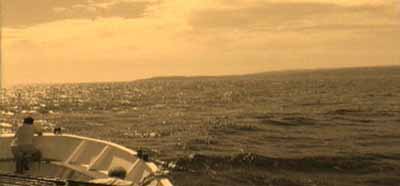
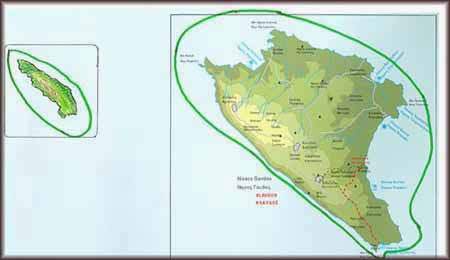
islet of Gavdos, opposite Sfakia, is the southern-most border of Greece and
Europe.
It
is 22 nautical miles away from Loutro,
right in the middle of the Libyan Sea.
According
to Callimachus, this is the ancient isle of Ogygia where, as Homer claims in
"Odyssey", the nymph
Calypso lived. Other names of Gavdos in the past were "Cavdos"
and "Clavdos" (Ptolemens
and Ierocles), "Glavdi" (the Epistles), "Gozzo" (the
Venetians).
In
the first Byzantine period, Gavdos had a bishop, as it had many inhabitants,
but, during the Venetian Rule, the islet was abandoned, as pirates sought
refuge there.
Until
the late 18th, early 19th century, Gavdos belonged to Sfakia and was part of
the Municipality of Anopolis
Sfakion. In 1925, it was pronounced a separate community, and remained part of
the county of Sfakia, until 1950.
Then,
since the majority of the locals had moved to Paleochora, Gavdos became part
of the county of Selino.
Bibliography mentions the existence of 172 inhabitants in the settlements of
Kastri, Ambelos, Vabiana and Metochia, as well as the existence of pre-war
settlements such as Drethiana, Xenaki, Galana, Fragliathana.
Today,
apart from the harbor Karave, there are three village on the islet: Kastri
(the capital), Vatsiana and Ambelos. The year- round inhabitants number
approximately 40.
Gavdos is shaped triangularly, its terrain plain and semi-rocky and the
climate warm and dry, with few rain showers. A big part of the island is
covered with pine-trees and cedars, the products of which are known for their
aphrodisiac qualities.
The
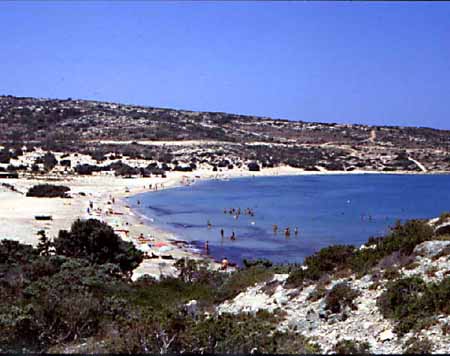
islet's beaches (Saracenico, Korfos, Tripiti, Ag. Ioannis, Potamos), having
recently won the award "Golden Starfish", lie here proud, golden,
with crystal waters.
|